The era of BC Rome was during the third century. The Romans were neighbors with the Greeks, and so the Greeks influenced their politics, mythology, science, as well as writing. Politically, the Roman government was ruled by a king as well as a senate. During this era of Rome, it was looked down upon to read and write. At the time, writing was only used for records. However, most could read and write. Writing was done on wax tablets using stylists, on stone using squared brushes and chisels. The Romans were fond of writing on papyrus, as well as carves stone or metal.
Clayton, E. (2014). Roman Foundations. The golden thread: The story of writing
(pp. #-#)
Wednesday, February 13, 2019

History: Middle Ages Rome.
During the middle ages of Rome, between the third century and the fifth century, it was unsuitable for the modern man to write. Within this era, it was looked down upon to write; however most Roman citizens could read. By the fourth century, Rome had twenty nine libraries. Typically slaves were taught how to write so they could copy or write books. Slaves also kept their master’s financial and legal records, and worked as secretaries and managers in their master’s business.In writing, there were two variations of the Roman script which was used by it’s citizens. The formal script was used for public monuments and books. The less formal script was used for “everyday writing” such examples include but are not limited to: informal purposes, lists, as well as note taking. This variation is believed to have been influenced by the experience of learning to write upon a wax tablet. Wax tablets had also influenced the Romans writing utensil of choice: the edged pen. Romans also wrote using a bone metal stylus, on either papyrus or parchment. By the end of this era, the Greeks were influenced by the Roman way of writing, and it soon spread eastward in a focus in Latin based languages.
Clayton, E. (2014). Roman Foundations. The golden thread: The story of writing
(pp. #-#)
Clayton, E. (2014). Roman Foundations. The golden thread: The story of writing
(pp. #-#)
Tuesday, February 5, 2019
History: Early Greece
Our journey starts in 334BCE, when the Greeks first began to realize that writing was as important as democratic values. To them, it had become an art form, something beautiful and important. It would be around 1000BCE when the Greeks would use the Cypriot system of writing. It would then be replaced, and influence for yet another system of writing. In approximately 1400BCE, It was replaced when the Greeks began to use the Syllabic system of writing. It was during this period, known as the Hellenic Period, when the first instance of writing on Papyrus was found. This system was not widely used, as the only found writings only revealed business transactions. This system was later replaced by a a phonetic system, adapted to the sounds of the Greek language. It is theorized that it was created in the area known as Cyprus. This new system seemed to also have been influenced by the Roman and Etruscan alphabets. It is because of this, by the 9th century Sillibic was no longer used by the Greeks. The new phonetic script had become very popular among the Greeks, soon splitting into two variants; The eastern Ionic alphabet and the western Ionic alphabet. The eastern alphabet would become the "standard," while the western variant would gain popularity on the island of Euboea. The standard alphabet has been proven to show that perhaps, the Greeks had taken influence from the Romans and the Etruscans. As the Greek letters for F, S,and L look strikingly similar to the Romans and the Etruscan letters. Delta, however, took a new look, it sat sitting up. The Greeks used the standard alphabet to carve inscriptions into their art, or to paint calligraphy onto pots. Brushes were made of reed and hair, while chisels were used to engrave the writing. By the 10th century, the Greek alphabet influenced the Italians, as that was when the first found instance of their alphabet was found there.
Clayton, E. (2014). Roman Foundations. The golden thread: The story of writing
(pp. #-#)
(pp. #-#)
Roman Rustic Calligraphy
Assignment Details:
- Explain that the alphabet you're working on is called Roman Rustic
- Explain which photos are practice and which are exploration
- Reflect on what you did, what you learned, what you liked or didn't like, what progress you made across the six 20-minute practice sessions
Assignment:
The alphabet I have been working on this week is called Roman Rustic. It was one of two ways the alphabet could have been written within the Roman Era. The other alphabet is called "uncial," and I will go over it next week in a blog post. Both alphabets have serifs, and the Romans did not have the letters J or U. The purpose of using Roman Rustic was to words seem more "old fashioned;" giving readers a sense that the work they were reading was important. To help visualize the alphabet, I have attached an image; the source can be found under it.


Image Source
Reflection:
What I did:
I spent a good amount of time writing in Roman Rustic, I practiced a lot with the hand movements, and finally I had also experimented with different tools and paper. In total I had spent around three hours in total practicing.
I spent a good amount of time writing in Roman Rustic, I practiced a lot with the hand movements, and finally I had also experimented with different tools and paper. In total I had spent around three hours in total practicing.
What I learned:
I learned how to write in Roman Rustic without having to look at the alphabetical guide. I also learned that special characters were non existent.
I learned how to write in Roman Rustic without having to look at the alphabetical guide. I also learned that special characters were non existent.
What I liked, What I didn't like:
I loved the style of writing, as I find styles close to the mid-evil era or the Victorian era lovely to look at. However, I absolutely did not like how there were no accents or special characters, such as ł, ć, ń, ó, ś, ź, ż, ą, or ę, within the given alphabet. This makes writing in Polish a hard creative task, due to these characters interfering with the serif.
I loved the style of writing, as I find styles close to the mid-evil era or the Victorian era lovely to look at. However, I absolutely did not like how there were no accents or special characters, such as ł, ć, ń, ó, ś, ź, ż, ą, or ę, within the given alphabet. This makes writing in Polish a hard creative task, due to these characters interfering with the serif.
Progress:
Over the whole time period I had worked on the assignment, I went from having to constantly look at the alphabetical guide, to memorizing the muscle memory for each letter. While my work may be a little sloppy, I'm sure over time it will grow into something beautiful.
Attachments:
Exploration/Practice: Monday 02.05.19
Today I wanted to explore some more, with a new medium and paper. While I was warming up, Owen asked what I was doing; and I let him try writing in Roman Rustic. Afterwards I played around a little bit using a blue highlighter. I wanted to spice things up as soon as I finished, and so I pulled out my fountain pen, some typewriter paper, and wrote out the whole alphabet. I tried to focus on all the letters, and some characters got written more because I needed practice with them. Afterwards, I wanted to try writing some simple Japanese characters using the fountain pen. I had spent maybe 40 minutes writing.


Exploration/Practice: Monday 02.04.19
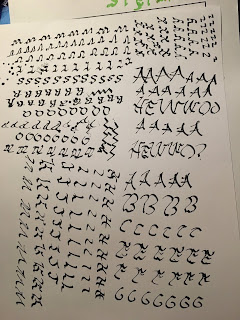
On Monday, my fountain pen had finally come in. I wanted to play around with it, and so I wrote the alphabet, each letter getting it's own block.
Exploration/Practice: Monday 02.05.19
Today I wanted to explore some more, with a new medium and paper. While I was warming up, Owen asked what I was doing; and I let him try writing in Roman Rustic. Afterwards I played around a little bit using a blue highlighter. I wanted to spice things up as soon as I finished, and so I pulled out my fountain pen, some typewriter paper, and wrote out the whole alphabet. I tried to focus on all the letters, and some characters got written more because I needed practice with them. Afterwards, I wanted to try writing some simple Japanese characters using the fountain pen. I had spent maybe 40 minutes writing.


Exploration/Practice: Monday 02.04.19
On Monday, my fountain pen had finally come in. I wanted to play around with it, and so I wrote the alphabet, each letter getting it's own block.

Exploration/Practice: Over the weekend:
Between 02.01.19 and 02.03.19, I had practiced the Roman Rustic Alphabet. My supplies had not arrived, and rather than using a double pencil, I had used a Prism marker on some high quality laser print paper. It was difficult to focus on the assignment due to my broken nose constantly hurting, so I had to work in small bursts. Overall I took my time with these pieces, and I accumulated almost three hours doing them.
Between 02.01.19 and 02.03.19, I had practiced the Roman Rustic Alphabet. My supplies had not arrived, and rather than using a double pencil, I had used a Prism marker on some high quality laser print paper. It was difficult to focus on the assignment due to my broken nose constantly hurting, so I had to work in small bursts. Overall I took my time with these pieces, and I accumulated almost three hours doing them.


Monday, January 28, 2019
Introduction
i) Hello, My name is Dusty and I am taking a calligraphy class at UMF. This is my first attempt at making calligraphy, as well as the first assignment for the class.
ii) When completing this assignment, I was unsure of where to begin with the unguided practice. As a computer science && mathematics major, I typically have a plan for what I am going to do. This unguided practice was a present surprise.
iii) My impression of this class so far is that it is quite dull. I have never been somebody who was big on English or Social Studies, however i'm sure that if I was, i'd find this class exciting.

Figure 1. Unguided practice.
Here is my transition from guided practice to free draw.

Figure 2. Unguided practice.
This image reflects the struggle of handling two pencils tied together.

Figure 4. Unguided practice.
A continuation of the alphabet.

Figure 3. Unguided practice.
I had decided to write the alphabet to help with my handling, as it is one of the things children do when they are learning to write.

Figure 5. Unguided practice.
I was in immense pain when I practiced on this page; so I drew my current mood as well as the words from a good memory.

Figure 6. Unguided practice.
I had tried to astray from my alphabet, and try and write in a different style.

Figure 1. Guided practice.
This is a guided practice sheet completed in class.

Figure 2. Guided practice.
This is a second guided practice sheet completed in class.
Subscribe to:
Posts (Atom)